
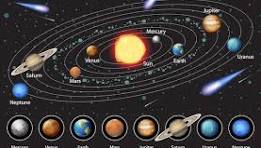
A truth stranger than fiction
No other planet (assumed to be so) has captured the wild imagination of an average Indian, other than RAHU and KETU. Sometimes I feel the conceptualisation of RAHU and KETU may be one of the earliest innovations in Virtual Reality – the duo does not exist physically, like Jupiter or Mercury, but they influence our imagination far more than the others. I need to choose between Augmented Reality and Virtual Reality as to where they really belong. Perhaps someone will develop an AI for this too …
Head without a body
tail that remembers the sky
eclipse within me
When the shadow swallows the sun,
who is truly dark —
the sky, or the one who cannot see?
……Appa
In the vast symbolic architecture of Indian thought, few figures are as enigmatic and psychologically rich as Rahu and Ketu. They are not physical planets in the astronomical sense, yet in Jyotisha (Vedic astrology), they are counted among the nine grahas — the forces that seize, grip, or influence human experience.
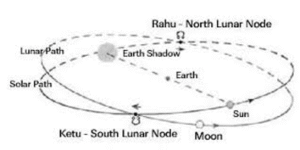
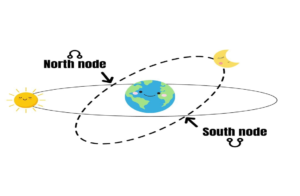
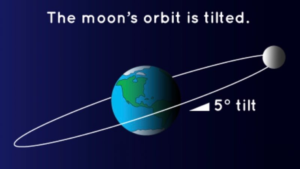
Astronomically, they correspond to the lunar nodes: the points where the Moon’s orbit intersects the ecliptic.
Symbolically, they are far more than coordinates; they are metaphors for desire and detachment, illusion and liberation.
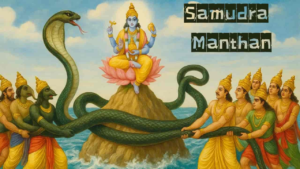
The Mythological Origins
Their story emerges from the great churning of the cosmic ocean — “Samudra Manthan.” When gods (Devas) and anti-gods (Asuras) churned the ocean to obtain amrita, the nectar of immortality, an Asura named Svarbhanu disguised himself and sat among the gods to drink the nectar. Just as the elixir touched his lips, Surya Sun and Chandra the Moon complained to Vishnu.
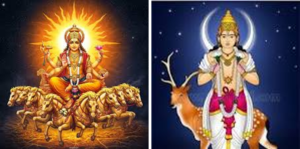
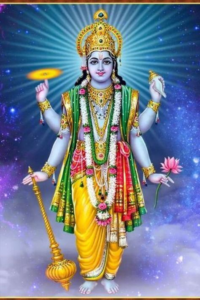
Vishnu then severed the asura’s head with the Sudarshana Chakra, but the nectar had already granted immortality. The head lived on as Rahu; the body became Ketu. Forever separated, forever incomplete.
This image is profound: Rahu is the head without a body — symbolising appetite without digestion, desire without satisfaction. Ketu is the body without a head — symbolising action without ego, movement without craving.
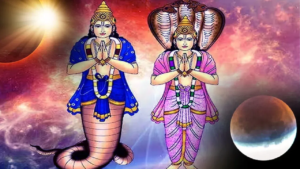
RAHU and KETU
Astronomical Reality
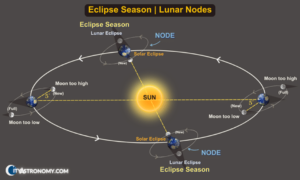
In astronomy, Rahu and Ketu are the north and south lunar nodes. When the Sun, Moon, and Earth align near these nodes, eclipses occur. Thus, Rahu and Ketu are mythically said to “swallow” the Sun and Moon, causing solar and lunar eclipses. In Western astrology, these correspond to the ascending and descending nodes, but the Indian imagination rendered them into living archetypes. Their invisibility is crucial: they are shadow forces, mathematical points yet capable of obscuring light. That symbolism carries into psychology.
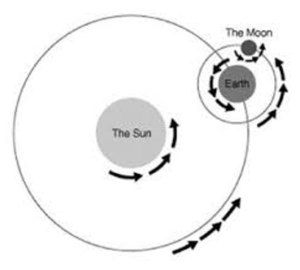
Moon 27 days approximate
Sun 25 to 27 days
Earth 24 hours , 365 days arounds sun
Rahu: The Expanding Hunger
Rahu represents ambition, obsession, foreignness, innovation, intoxication, and boundary-breaking energy. It is material hunger, but also the hunger for experience. Rahu pushes outward — toward fame, technology, politics, disruption, taboo-breaking. It is the immigrant’s drive, the revolutionary’s impatience, the entrepreneur’s risk. Rahu is not inherently negative. Without Rahu, there would be no scientific breakthroughs, no social reform, no crossing of oceans. But Rahu’s challenge is insatiability. Because it is only a head, it cannot feel full. It consumes endlessly. Psychologically, Rahu shows where one feels an exaggerated pull — an area of life that seems magnetic and urgent. It can produce genius or addiction. It can create charisma or scandal.
If Rahu is expansion, Ketu is contraction
Ketu: The Contracting Flame
Ketu signifies detachment, past-life residue (in karmic astrology), mysticism, loss, renunciation, and inner awakening. It dissolves identity. Where Rahu says “I want,” Ketu says “I have seen through this.”Ketu can create confusion, isolation, or sudden breaks. Yet it also grants spiritual insight. Many mystics, researchers, and unconventional thinkers have strong Ketu influences. It cuts illusions sharply. Ketu’s body-without-head symbolism suggests instinctive intelligence — action without egoic commentary. It can represent inherited talent, something already mastered, yet no longer fulfilling.
The Axis of Evolution
Rahu and Ketu are always exactly opposite each other in a horoscope, forming an axis. They are not independent forces but a polarity. One shows where we are pulled toward new growth; the other shows where we must release attachment. This axis can be interpreted as a tension between material expansion and spiritual contraction. Between acquisition and renunciation.In modern psychological terms,
Rahu corresponds to the unintegrated shadow-desire — the future we crave. Ketu resembles the exhausted pattern — the past we carry. Neither is good nor bad. Both are necessary.
Eclipses and Consciousness
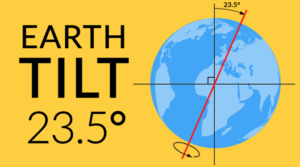
The tilt of the Earth, the tilt of the Moon, the difference in elliptical part of the Earth around the Sun that defines perihelion and epihelion , all combine to give the occultation of the SUN and the MOON , leading to teh SOLAR and LUNAR eclipses ,During eclipses, traditional Indian households once observed silence, fasting, or meditation. Symbolically, an eclipse is a temporary obscuring of clarity. Rahu swallowing the Sun can represent confusion of identity; swallowing the Moon, emotional turbulence. Yet eclipses also mark turning points. They interrupt normal light. In personal development language, they resemble crises that reorient life.
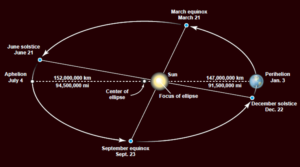
Perihelion and epihelion
Philosophical Reflection
From an Advaitic lens, Rahu and Ketu are not external demons but inner movements of consciousness. Desire and detachment arise within awareness. The self that chases and the self that withdraws are both modifications of the mind.
Rahu says: “Become”-Ketu says: “Be”-Rahu builds identity, Ketu dissolves it.
One is centrifugal, the other centripetal. Together, they form the rhythm of human evolution.
If Rahu represents the unfinished hunger of the cosmos experiencing itself, Ketu represents the remembering that nothing was lacking.
Contemporary Relevance
In a hyper-connected digital age, Rahu energy is amplified — social media visibility, technological acceleration, global ambition. At the same time, burnout, retreat culture, and mindfulness movements reflect Ketu’s counterbalance. A society dominated by Rahu becomes restless and unsatisfied. A society dominated by Ketu may stagnate or withdraw. Balance lies in conscious engagement: striving without addiction, detachment without apathy.
Humans fear
Loss of control — Loss of identity — Unpredictable eventsThe nodes trigger exactly these
Karmic Acceleration
Rahu and Ketu are considered karmic indicators: Rahu pushes you into unfamiliar territory. Ketu pulls you away from attachments you cling to. Growth rarely feels comfortable.
Hence, what is mistaken for misfortune actually accelerates evolution.
Our Realization
Rahu and Ketu are not merely astrological markers; they are metaphors for the human condition. The head that wants to taste immortality and the body that moves without knowing why. We live between them.
Every aspiration carries Rahu’s fire. Every surrender carries Ketu’s ash.
In understanding them, we are invited not to fear shadow, but to integrate it — to recognise that growth and release are twin movements of the same cosmic dance.

Appa
Tales, Tails & Trails
Ram Iyer retired as the Project Director from the Science & Technology Park, an initiative of the Department of Science & Technology, Govt. of India, with a B.Tech. and an MBA from the University of Delhi. Getting Bharat, that is India, back to its roots through Ancient Vedic Wisdom and Science & Technologies is the mission he is on. Post-retirement, he actively supports Nisargshala’s mission, lending his scientific knowledge to nature-based education and stargazing initiatives
Thank you Appa garu.
In astrology these two names ie Rahu and ketu are familiar but not in existence and I am so confused what actually they are?
Beutiful explanation of these virtual planets by Appa ji.
In Hindu mythology, Rahu and Ketu were born from the story of Samudra Manthan, but astronomically they represent the ascending and descending nodes of the Moon. A beautiful example of how ancient wisdom blended storytelling with sky observations.
Dear Prasad garu
Thank you for your observations, as a statr guide intern, these tidbits are very crucial for conducting a good narrative in star gazing sessions
please include these trivias of science and myth
also requesting your read of all the other blogarticles
Ram Iyer’s essay is not about astrology — it is about the human condition. Using Rahu and Ketu, the mythic lunar nodes born of the Samudra Manthan, he reinterprets them as timeless psychological forces: Rahu as restless ambition and expansion, Ketu as detachment and dissolution.
With elegant simplicity, the piece moves from mythology to modern life, positioning Rahu as the energy behind today’s hyper-connected, achievement-driven world, and Ketu as the quiet pull toward mindfulness and retreat. The line, “Rahu says: Become. Ketu says: Be.” captures the heart of the essay.
Thoughtful, symbolic, and contemporary, this work reframes ancient cosmology as a mirror to our inner struggles between striving and surrender. It is reflective writing that turns shadow into insight.
Thank you, dear Yegnesh, for going through the article and giving us your key inputs