
It’s Winter for a Reason

Seasons
Seasons! How much they impact us, how much are we dependent on them, how much have they entrapped us, in body, in mind, in consciousness (the deha, the manasa, the chaitanya), be it food, be it clothing, be it shelter, be it any form of human desire, seasons become the controlling elements in an omnipresent, omnipotent manner. It would be an oft-repeated cliché to mention that the world of fine arts draws inspiration from the seasons – Poetry, Prose, Drama, all have drawn fuel from the immense energy stored in season’s canisters.
…. Time turns kind, teaching hearts to stand.
Soft spring wakes, where silent roots dream,
For summer to pour gold upon the patient land;
Then Autumn walks slowly, with the radiant sunbeam
As winter stills, breathing wood and sand….
Thus, time turns kind, and teaches hearts to stand……
……. APPA
To Nature’s greatest gift to Earth, we dedicate these season-specific articles, for the sake of focused understanding of seasons and the night skies, we have categorised them as:-
Period Mid- November to Mid-March Hemanta Shisira Ritu
This article showcases Hemanta Shishira Ritu – Early Winter — Late Winter
Companion articles to follow at appropriate times shall be
- Period Mid-March to Mid-May Vasantha Ritu– Spring
- Period Mid-May to Mid- July Greeshma Ritu — Summer
- Period Mid July to Mid-September Varsha Ritu–Monsoon
- Period Mid- September to Mid -November Sharad Ritu– Autumn
How Seasons Educate Us
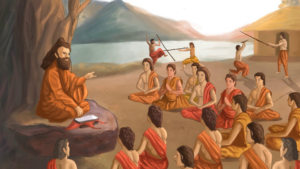
With the march of time, we have been formatted to follow a school calendar that did not connect with nature as a canvas, relegating it to, maybe a subject in science, or maybe a theme in prose/poetry, but it was not always. Our Ancient wisdom emphasised the Seasons being at the core of the method and practice of teaching. In other words, pedagogy itself. In a Gurukul or a Pathashala, the pace and emphasis of study depended on seasons, based on the curriculum.
It mattered because Indian education aligned learning with RTU CHARYA (read rithucharya) “Seasonal Discipline “because Body, Mind and Environment were very closely connected to ensure better retention, health and equanimity.
The Cause of Seasons
We saw how Seasons affect us; let us see how seasons are caused in a brief manner, since we have covered it before. The Rotation, Revolution and the Axial tilt of the Earth, combined with the Gravitational Torque of the Moon and the Sun causes the Seasons. Above the Equator and below the Equator are called the Northern and Southern Hemispheres. They behave in a manner of mirrored opposition. When it’s Spring in the North, it’s Autumn in the South, Summer in the North, Winter in the South
March (Equinox): Spring (North) / Autumn (South)
June (Solstice): Summer (North) / Winter (South)
September (Equinox): Autumn (North) / Spring (South)
December (Solstice): Winter (North) / Summer (South
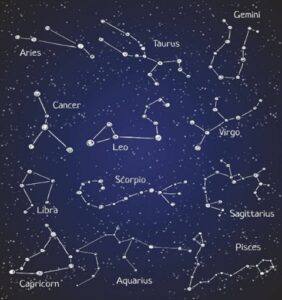
When we see the night sky, the sky moves in the window about the celestial equator, and different constellations become visible as the year progresses. This pattern repeats every year.
Seasonal Constellations along the Ecliptic (Northern Hemisphere), the belt of 8 to 9 degrees about the ecliptic in which the Rashis (Zodiac) move
.
Hemanta Shisira Ritu (Early and Late Winter Season)
Mahakavi Kalidas, writing so elaborately and passionately about the seasons in his epic work RITUSAMHARA, ऋतुसंहार (a garland of seasons), does not merely describe seasons, but he reveals how nature, emotion, and human life move synchronously. Nisargshala respects this genius by quoting his season-inspired shlokas from the epic poem in 6 cantos, each for a season.
नीहार पातैः कुसुमैः समन्ततः
वनानि रम्यानि विभान्ति शीतले ।
Nīhāra-pātaiḥ kusumaiḥ samantataḥ
vanāni ramyāni vibhānti śītale
“In the cold season, forests appear beautiful, covered everywhere with frost like fallen flowers.”
During the period, Hemanta Shishira Sun shall be traversing the second half of Vrischika (Scorpio), Dhanu (Sagittarius), Makara (Capricorn), Kumbha (Aquarius) and the first half of Meena (Pisces)/Based on the Lunar months, the months would be the second half of Kartika, Mrigasirsa, Pausa, Magha, and first half Phalguna.
We experience one of the best periods in a year, the mid-November to mid-March period, called the HEMANTA -SHISIRA RITU. As Hemant yields gently to Shisira, the Indian night sky comes into its finest clarity. The monsoon dust has settled, humidity recedes, and the air grows crisp. These months—stretching from mid-November to mid-March—offer the most rewarding stargazing of the year. The sky seems deeper, darker, and closer, inviting both the casual observer and the patient sky-watcher.
Early evenings begin with a fond farewell to the summer constellations.
Clear weather, sharp mental alertness gave focus to Sastrartha (Debates), Jyotisha (Astronomy), Ganita (mathematics), Vigyana (Science), Dharma Shastra (Higher levels of Philosophy). These were the subjects of focus during the Hemant-Shishir period.
Hemant Ritu Mid November to Mid-December
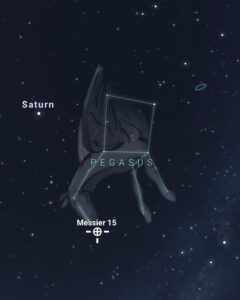
Pegasus — the “Great Square.” This marks the end of the 27 Star Mansions of Indian Astronomy, which correspond to Purva Bhadrapada, Uttara Bhadrapada, and Revati, respectively, with Markab (Alpha Pegasi) and Scheat (Beta Pegasi). This group varies between about 150 light-years and 700 light-years
Andromeda — Named after the daughter of Cassieopia, the queen of Ethiopia, both women being contenders for the status of the most beautiful woman, it lies near Perseus, Pegasus, and Cassieopia (all three connected mythologically). The terminal Zodiac of Meen (Pisces) is also close. It is contained within the Dirgha Ganga (Andromeda Galaxy), the galaxy nearest to the Akashganga (Milky Way), about 2.5 million light-years away.
The star constellation Andromeda lies between 100 and 350 light-years away, considering Andromeda in its 3 separate forms, Alpha, Beta and Gamma. The Andromeda galaxy is on a collision course with the Milky Way and is expected to collide in about 4 to 5 billion years
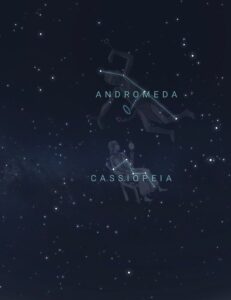
ANDROMEDA CONSTELLATION
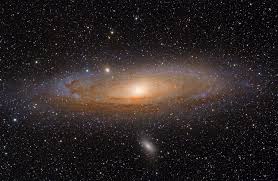
ANDROMEDA GALAXY
Sharmishta – Cassiopeia — M -shaped constellation that is a star gazers delight, because of it is rather easy to identify in the form and shape of the alphabet M. Like the Sapta Rishi (Ursa Major), Cassiopeia is also circumpolar and when it sets, we can see the Sapta Rishi rise in the sky Like the Sapta Rishi Sharmishta is also used to locate Dhruva (Polaris)
उत्तरे नभसि शार्मिष्ठा विराजते वक्ररूपिणी ।
पञ्चतारकया युक्ता मुकुटेव प्रकाशते ॥…अप्पा
uttare nabhasi śārmiṣṭhā virājate vakrarūpiṇī |
pañca-tārakayā yuktā mukuṭeva prakāśate ||
In the northern sky shines Sarmistha, curved in form; adorned with five stars, she glows like a radiant crown.
SHARMISHTA – CASSIOPEIA
Meen (Pisces) the 12th Zodiac in the celestial equator — It is a faint star cluster but present overhead, it is important astronomically because the VERNAL EQUINOX which was in ARIES has shifted to Pisces about 2000 years ago (estimated in 70 BC to 68 BC) and will move to Aquarius about 2600 (about 575 years are still there !!) this astronomical event is a subject of intense separate discussion called Precession.
Meen comprises Purvabhadrapada (alpha and beta Pegasi), Uttara Bhadrapada (gamma Pegasi and alpha Andromeda). Revati (zeta piscium). A striking feature in Pisces is the circlet, which is located by positioning Pegasus and moving slightly East
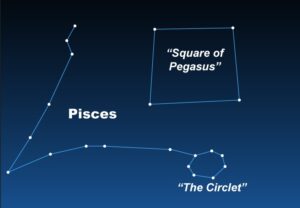
Shishir – Winter
Winter has the brightest stars of any season, and is considered a stargazer’s annual pilgrimage, with many cosmic activities in fray like the meteor shower Leonids in November the major meteor shower Geminids in December, the winter Ursids in late December and the remarkable Quadrantids early January, it’s a real glorious sparkle in the sky and this spectacle is further complemented by the clear visibility many with naked eyes of star clusters listed below
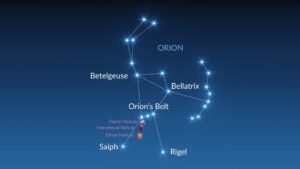
Mrigashira – (Orion) sometimes called Prajapathi, especially when evoked in rituals —is the most famous winter constellation; it is easy to spot, featuring Betelgeuse, the star associated with Rudra, a well-known red supergiant nearing the end of its life, complemented by Rigel, a fantastic blue brilliance. This group symbolises search, curiosity and pursuit (all characteristics of objective-based management). We can also spot the deep sky nebula – M42, the Orion nebula, which is about 1300 light-years away. Orion’s Belt, another popular group, has three stars – Alnitak, Alnilam, and Mintaka – some cultures call them the Three Kings; others call them the Three Wise Men who visit the Baby Lord Jesus in the Manger, and still others align these with the Pyramids of Giza. It must be noted that when the Pyramids were being constructed, the Pole star was not POLARIS (alpha Ursae) but THUBAN (alpha Draco)
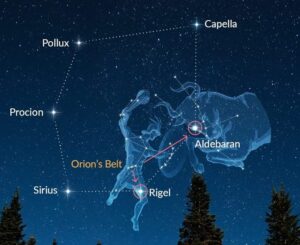
The Hunter Orion charges at Taurus the Bull
Vrushabh Rashi – Zodiac Taurus — includes Rohini (Aldebaran-alpha tauri) and the Seven Sisters Kritika (Pleiades), is easy to locate even for beginners once they get the hang of the sky. That’s because of the two-star clusters, the V-shaped Rohini Gana (Hyades) and the small but distinctive stars of the Kritika Pleiades. When we position ourselves with the Orion, we will know we are looking in the right place. Overall Taurus distance spread is about 60 to many thousand light years away
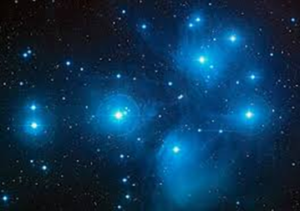
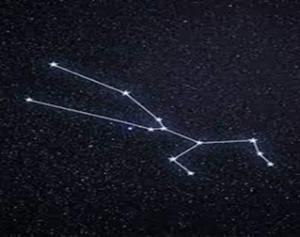
Krittika & Vrushabn Rashi
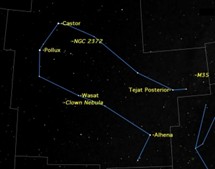
Mithun Rashi Zodiac Gemini — called fondly as the twins. Bright stars Castor (alpha Geminorum) and Pollux (beta Geminorum) are the main identification points; they are about 30 to 50 light-years away. These form the nakshatra Punarvasu; Castor is the immortal twin and Pollux the mortal twin.
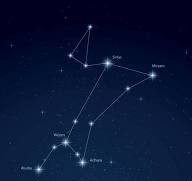
Maha Shwana -Canis Major is a prominent southern constellation famous for Sirius, the brightest star in the night sky (the “Dog Star”). It is believed to be one of Orion the Hunter’s loyal hunting dogs; what can also be seen is a deep-sky object like M41. Sirius (Alpha Canis Majoris): The dazzling bright star is crucial to the Rabi season, and as the star is seen as rising at Sunrise the Rabi season of agriculture commences. In Egypt, this event was called the flooding of the Nile
All seasons are blessings, each one good in its own way; they have a purpose for the benefit of all living and nonliving. It is this collaborative, cooperative, constructive spirit that Alexander Dumas says in The Three Musketeers, “Tous pour un et un pour tous” (ONE FOR ALL and ALL FOR ONE). An interplay that Nature gives us so that Man may live and contribute to the ultimate benefit of Mankind. We at Nisargshala would like to share this with you all….Come to Nisargshala!!!

Appa
Tales, Tails & Trails
Ram Iyer retired as the Project Director from the Science & Technology Park, an initiative of the Department of Science & Technology, Govt. of India, with a B.Tech. and an MBA from the University of Delhi. Getting Bharat, that is India, back to its roots through Ancient Vedic Wisdom and Science & Technologies is the mission he is on. Post-retirement, he actively supports Nisargshala’s mission, lending his scientific knowledge to nature-based education and stargazing initiatives.
Winter, perhaps, is nature’s quiet rebellion against our obsession with speed.
When the world slows, leaves fall, and daylight retreats, we are gently reminded that productivity is not always about movement—it is sometimes about pause.
This piece invites us to see winter not as absence, but as intention. A season that strips life to essentials, asking us to listen rather than act, to conserve rather than consume. In a world addicted to perpetual summer—of growth, noise, and visibility—winter becomes a necessary counterbalance, teaching restraint, resilience, and inner warmth.
Maybe winter exists not to test our tolerance to cold, but to test our comfort with stillness. And in that stillness, we rediscover what truly sustains us.
Dear Yegnesh
Your broad views are indeed appreciated
Please keep publishing such articles. It was wonderful to correlate the Indian and Greek names.
Dear Dr A Chakravarthy
We sincerely appreciate the kind words. We hope that one day you shall come and see for yourself how the poem twinkle twinkle little star sounds in actual life.
Most beautifully, the note reminds us that our ancestors did not compartmentalize life: education, health, observation, and contemplation flowed with the seasons. The closing invitation is gentle, not promotional—an extension of shared wonder—making the call to experience these skies at Nisargshala feel natural and heartfelt.
Overall, this is not just an introduction to an essay; it is an invitation to realign oneself with time, sky, and self. Quietly profound, culturally rooted, and emotionally resonant.
Thank you Sir, we shall try to provide quality information