
Understanding Shunya, Atishunya, Mahashunya & Sarvashunya
In our ancient Hindu Vedic Sanskriti, great yogis and sages explored not only the outer universe, but also the inner universe of the human mind. While exploring this inner world, they discovered four powerful states of consciousness: Shunya, Atishunya, Mahashunya & Sarvashunya. These words may sound difficult, but their meanings are very simple, beautiful, and deeply healing.
1. Shunya – The Sacred Emptiness
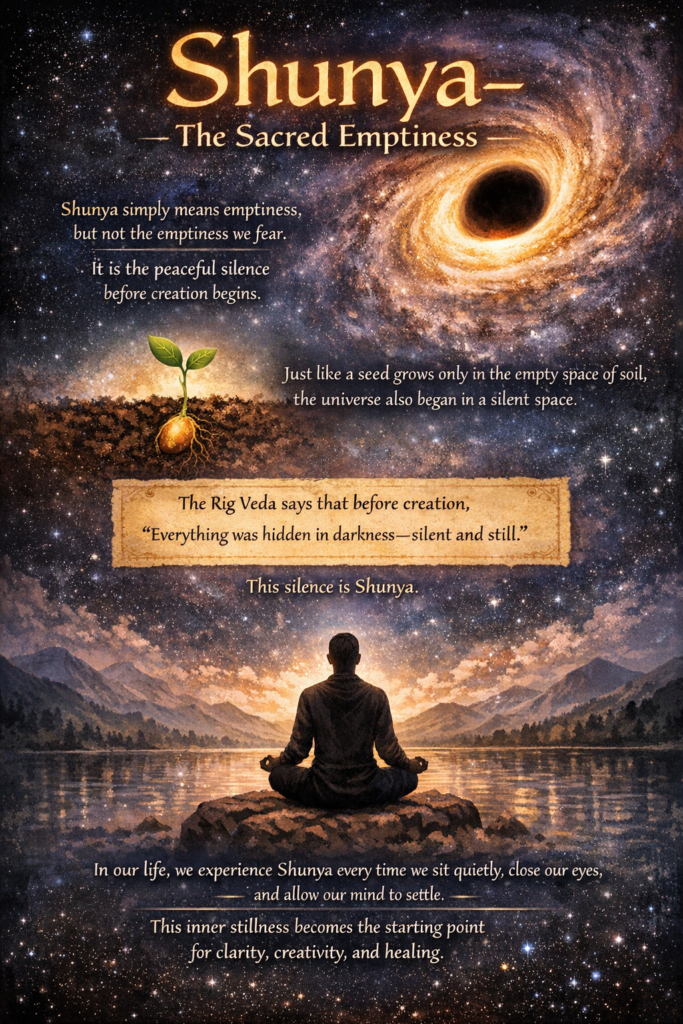
Shunya simply means emptiness, but not the emptiness we fear. It is the peaceful silence before creation begins.
Just like a seed grows only in the empty space of soil, the universe also began in a silent space.
The Rig Veda says that before creation,
“Everything was hidden in darkness—silent and still.”
This silence is Shunya.
In our life, we experience Shunya every time we sit quietly, close our eyes, and allow our mind to settle. This inner stillness becomes the starting point for clarity, creativity, and healing.
2. Atishunya – The Expanded Silence
It is a deeper form of Shunya. Imagine the mind becoming so quiet that it starts to feel open, spacious, light, and free.
This is Atishunya — the mind expanding beyond everyday noise.
It usually happens during:
• Deep breathing
• Meditation
• Repetitive drawing like Mandalas
• Being in nature
• Watching a sunrise or sunset
In Mandala Therapy, when a person draws a repeating pattern slowly, the mind naturally enters Atishunya. It is not forced; it happens gently. Thoughts slow down, and inner peace expands.
3. Mahashunya – The Great Void
It means the Great Space — a state where we go beyond thoughts, emotions, and even the idea of “me” and “mine.”
The Upanishads call this the state where the seeker experiences true freedom.
We can understand it through a simple example:
Between two breaths, there is a tiny pause.
In that pause, there is no past and no future.
There is only presence.
This pure presence is Mahashunya.
It is not something mysterious.
It is a natural experience available to every human being, especially when they learn to quiet their mind.
4. Sarvashunya – The Wholeness in Emptiness
It is the highest state — when emptiness becomes completeness.
In this state:
There is no separation between you and the universe,the mind and the heart,the inner world and the outer world.Everything feels connected, meaningful, and full.This is the state sages describe as oneness, where love, compassion, and wisdom flow effortlessly.
Many tantric mandalas show this through circles moving towards a single central point — the bindu.
This bindu represents Sarvashunya, the point where all forms dissolve into pure consciousness.
How These Four States Connect with Mandalas
A Mandala is therapeutic . It is a geometric mirror of the universe and the mind.
• The centre point of the Mandala represents Shunya – the origin.
• As the patterns expand outward, we experience Atishunya – the mind opening.
• When we lose ourselves in the drawing, forgetting time and thoughts, we enter Mahashunya.
• And when the mandala is complete, we feel a sense of wholeness, which reflects Sarvashunya.
So a Mandala is not just a drawing.It is a journey of consciousness.
How These Concepts Affect the Human Body and Mind
Body:
When the mind enters Shunya or Atishunya, the nervous system calms down.
Stress reduces, breath becomes slower, digestion improves, and hormones balance.
In Mahashunya, the body enters a deep relaxed state that supports natural healing.
Mind:
These states bring:
• Clarity
• Emotional stability
• Creativity
• Inner confidence
• Reduced overthinking
• More compassion
When someone reaches glimpses of Sarvashunya, they feel connected, purposeful, and aligned with life.
Why This Knowledge is Important Today:
In today’s busy world, people run after noise, results, and perfection.
But our ancient culture teaches us that the real treasure lies in silence, space, and stillness.
Understanding Shunya and its higher states helps us:
• Slow down
• Feel grounded
• Heal emotionally
• Discover our inner strength
• Live more consciously and peacefully
And through simple practices like Mandala drawing, breathwork, chanting “ॐ,” or spending time in nature, anybody — even a beginner — can experience these sacred states.