
Glow of a Million Stars

Since times immemorial, we on the Earth and all our brethren, be it the animals, the plants, the birds, the bees, the fishes, and so many other species and forms of life, have all looked at the Night Sky and wondered, some overawed, some elated, sometimes frightened at its fury, sometimes ecstatic at its display……
……A sense of awe the sky commanded,
a hush across the hills it landed.
Each pristine stone could still recall
how small it stood beneath it all……
………Appa
To this ageless wonder, we dedicate this article.
It’s The Moon Once Again!!
The ancient wisdom of “Bharatvarsha” organised the sky by the rotation of the moon, which became an important reference to celestial mapping. Supported by persistent observations, lacking appropriate modern equipment and instrumentation, they determined that the moon takes 27.3 Earth days to complete one sidereal orbit around the Earth. The term sidereal means relative to the Stars rather than the Sun. A Solar day is 24 hours, and a sidereal day is slightly less, by about 4 minutes, because of Earth’s own rotation and its own orbit.
We call this the sidereal month.
Ancient wisdom segmented the sky into 27 equal portions and called each a Nakshatra (star mansions)
Applying very rudimentary mathematics, as the dome of the sky is 360 degrees, we divide 360 by 27 and get 13.2 degrees (actually 13.3, but it is a recurring decimal),
The moon takes 27 days to go around the Earth, and there are 27 nakshatras, so we have approximately 1 nakshatra per day
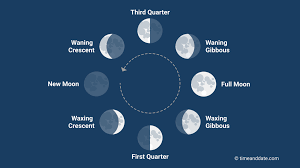
The motion of the moon (because of its uneven surface and varied distribution of mass) is not uniform; there is an angular relationship of the Moon with the Sun yielding 15 waning phases and 15 waxing phases – the full cycle yields 29.53 Earth days to complete one month, and is called a Synodic month.
In Short!
- The Moon completes 27 nakshatras in 27.3 days
- The Moon completes one full cycle of phases in 29.53 days
- 29. 53 is NOT equal to 27.3
- We can conclude that the same phase shall not occur in the same nakshatra
Our days begin with Sunrise and end with Sunset. This is the reason why, when we superimpose our calendar over the Gregorian Calendar, our day (thithi) usually overlaps two calendar days.
When we study planetary motions from Earth, to observe astronomical aspects, we assume that we are stationary and all the other heavenly bodies, like the Sun, Moon, Stars, and the Heavens, move around us. The huge distances that exist between Earth and them make this relative motion understanding simple, causing the heavenly dome to be divided into 12 equal parts of 30 degrees each, and become the months of the year.
We Have a Calendar!!
Based on the movement of the SUN, a SOLAR calendar (SOURAMANAM) is seen from the point when the SUN is in the ARIES constellation. The Vernal Equinox and ARIES SUN entry were on the same day till about 2000 years ago (That is why we have the SOLAR calendar in India beginning on MESHA VISHU ). Still, due to a fact called axial precession, the Sun shift about 1 degree every 72 years. The vernal equinox occurs when the Sun is in MEEN (PISCES), which is slowly drifting toward KUMBH– AQUARIUS. Since all the astronomical /astrological calculations are based upon SUN/ARIES/MESH, we still follow the current Vishu system and have frozen the position. This is a reference that is used in all ritualistic situations. Kerala, Tamil Nadu, Bengal, and Assam celebrate their New Year on this day. The axial precession is the subject of a soon-to-appear blog called the Pole That Was.
A second one is based on the movement of the MOON – called the LUNAR calendar (CHANDRAMANAM), which can be further categorised as
- The NEW MOON referenced (AMAVASYANT- ending on a new moon) a calendar that is popular and is used in states like Maharashtra, Karnataka, Andhra, Telangana, Goa, some parts of Madhya Pradesh, Dadra and Nagar Haveli, Daman, Diu – technically called as Chaitra Shukla Pratipada (first tithi of the waxing moon phase becomes 1st of CHAITRA month becomes New Years Day)
- The Purnima in which the FULL MOON is referenced (PURNIMASYANTA-ending on a full moon) is the calendar that is followed in the northern states UP, Bihar, Jharkhand, Himachal, Haryana, Delhi, Punjab, Rajasthan, Madhya Pradesh and Chhattisgarh. Ashvin Krishna Pratipada (1st Tithi of the Waning moon, 1st of ASHVIN month becomes their New Year’s Day).
We have an Ephemeris /Panchang!!
An Ephemeris is what we call in our local tongues as “PANCHANGA”, which literally means 5 Angas or Limbs. Similar to the manner in which we give our location on various apps for obtaining services like Swiggy, Ola, Uber, etc., we give the following to identify our cosmic location using:-
- The name of the year is the SAMVATSARA ( a block of 60 repeating names we are now in VISVAVASU)
- The motion of the Sun, whether northward or southward called AYANA- UTTARAYANA or DAKSHINAYANA for the Sun over the Tropic of Capricorn -Makar Rashi, called the Winter Solstice or Sun over the Tropic of Cancer – Karaka Rashi, called the Summer Solstice.
- The SEASON, we have 6 seasons in the Indian system (Vasant, Grishma, Varsha, Sharad, Hemant and Shishir stated as Spring/Summer/Rain/Early Fall/Late Fall/Winter}
- The MASAM or the Month
These are common for a relatively longer time in any given year, and what changes daily becomes the Panchang
The 5 Angas (Panch-Anga) are: –
- Tithi (lunar day) – 15 each paksha as explained before.
- Vara (Day of the week)- 7 (seven)
- Nakshatra 27-star mansions (the Arabs call it the MANZILS).
- Yoga – the angle between the Sun and the Moon, which in turn determines the phase.
- Karana – which is one half of a Tithi.
These are used to analyse/advise on the conduct of events (we shall be dealing with Muhurta and Lagna separately). The Panchang is used extensively for determining the correct time of Sunset and Sunrise, Moon Set and Moon Rise. to sow crops, predict eclipses, fishing in deep seas, and establish auspicious intervals of the day for rituals and functions.
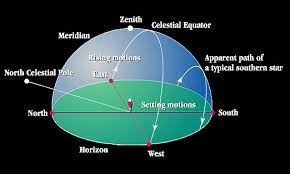
The Celestial Equator
When we look up at the Sky, even though we see it in parts, we can definitely comprehend “The Rashis”, also called “The Zodiac”. These originated in early Babylonian Astronomy and have remained by far the same all over; of course, their names may have changed as we have in India.
We are all aware of an imaginary line going around the Earth called the Equator, which divides (for all practical purposes) the Earth into two distinct halves, the Northern Hemisphere and the Southern Hemisphere.
This imaginary line is projected in the sky to form a great imaginary circle, which also divides the sky into the northern hemisphere and the southern hemisphere.
Northern is what we see in India, and Southern is what one would see in countries say as Australia. As the Earth rotates (but we assume it to be stationary), the stars appear to rise in the East and set in the West.
The Ecliptic or Elliptic
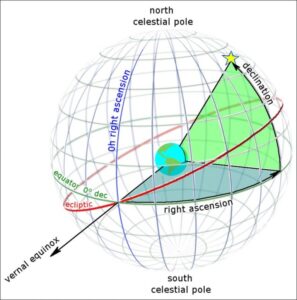
Like the Equator is an imaginary line in both Earth and Heavens, and as we have the Tropics (tropic of Cancer, tropic of Capricorn) to balance the tilt of the Earth by 23.5 degrees, similarly, an imaginary circle is drawn at an angle of 23.5 degrees to the Celestial Equator; this line is called the Ecliptic or Elliptic. The point where the ecliptic and the Celestial equator intersect is called the Equinox, because of which we have the seasons. Equinox means day and night are equal.
The Zodiac
The Zodiac is a band that extends both sides of the Ecliptic and is about 8 to 9 degrees on either side of the Ecliptic, which means it is a 16 to 18-degree broad band. This houses all 12 Zodiac signs. When we see from Earth, the Sun, the Moon, and all the Nakshatras appear to move through these heavenly windows.
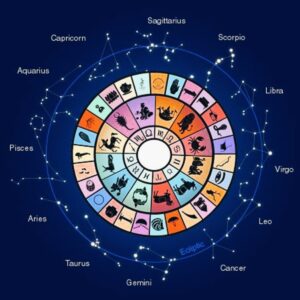
Rashi Charkra
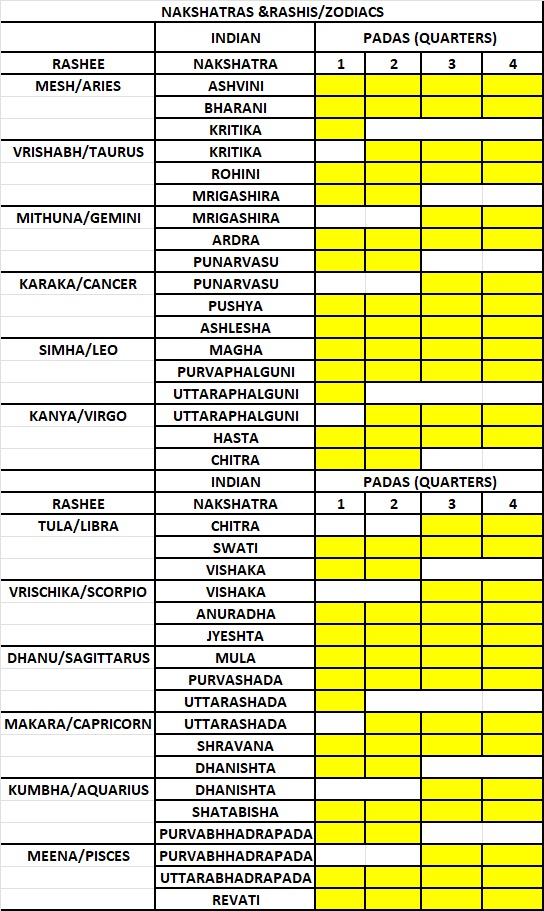
The Nakshatras in the Rashis
The Sky is all around us, and the Sun and the Moon and the Nakshatras appear to go around us. Going a full round is a circle that is 360 degrees. We just understood the Zodiac belt to be a 9-degree belt on both sides of the ecliptic. We have 12 Zodiac signs or Rashis. Each Rashi is 360 divided by 12 equals 30 degrees. We have 27 Nakshatras or Star mansions. Each Nakshatra or Star mansion is 360 divided by 27, which we take as 13 point 2 (actually it would be 13,3333). Each nakshatra or star mansion has 4 padas (4 quarters). Each pada would be 3 degrees 2 minutes (13.2 divided by 4). Each of the Rashis will have 9 allocated /occupied/placed padas (3.2 multiplied by 9 will be 28 plus degrees, which is almost 30 degrees and one Zodiac. In simple terms, each Rashi will have 2 full nakshatras and one-fourth (1/4) of the next nakshatra.
To understand the placement of the Nakshatras in the Rashis and the padas they cover or straddle across two Rashis is quite clear in the table appended.
Let’s exemplify one to show how!
Mesh Rashi Aries will have a total of 9 quarters – the star Ashvini will occupy four (4), the star Bharani will occupy four (4), and Kritika will get one (1) in Mesha, and she will straddle across to Rishabh (Taurus) for her next three (3) padas.

Millions of Stars glow upon us as we look up to the infinity the Space provides us, overpowering us — yet Man, in his infinite wisdom, has been a discoverer, an explorer possessing tremendous imagination.
We respect and recall René Descartes, one of the great modern thinkers who made possible the imagining of space itself with the concept of 3 dimensions.
“DUBITO COGITO ERGO SUM” — I doubt, I think, therefore I am
We also recall with due respect the opening frames of “STAR TREK” a TV series that captured the fancy and imagination of many of us during our Sunday morning tryst with the Television, in its early stages in Doordarshan. “Space: the final frontier. These are the voyages of the Starship Enterprise. Its mission: to explore strange new worlds; to seek out new life and new civilisations; to boldly go where no man has gone before.
Come to Nisargshala – we shall take you there!
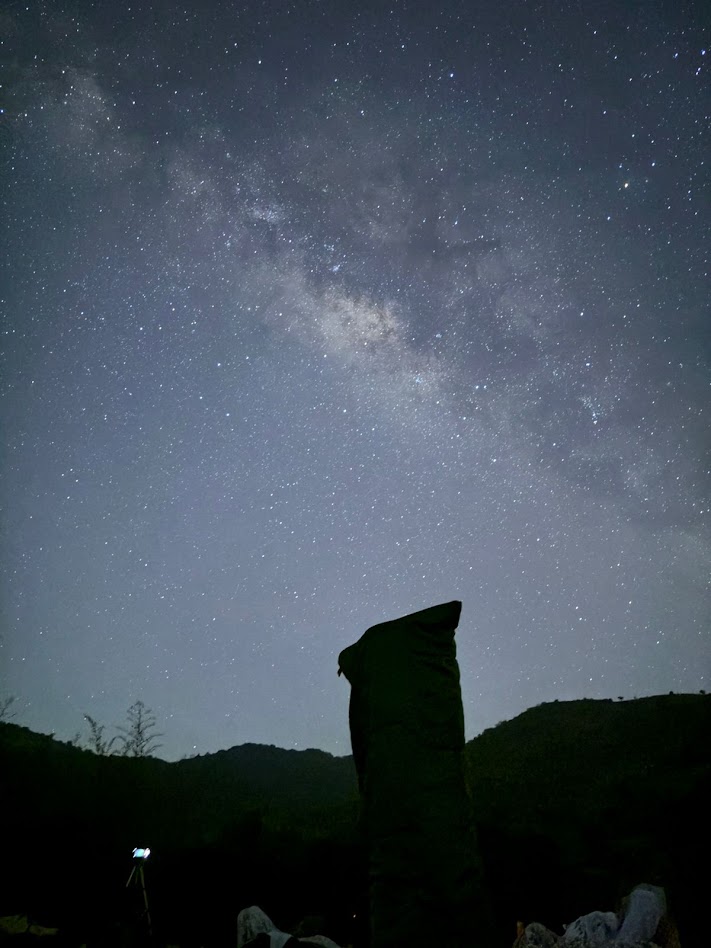

Appa
Tales, Tails & Trails
Ram Iyer retired as the Project Director from the Science & Technology Park, an initiative of the Department of Science & Technology, Govt. of India, with a B.Tech. and an MBA from the University of Delhi. Getting Bharat, that is India, back to its roots through Ancient Vedic Wisdom and Science & Technologies is the mission he is on. Post-retirement, he actively supports Nisargshala’s mission, lending his scientific knowledge to nature-based education and stargazing initiatives.
Lovely article and so informative. I especially like the way you connected to my favourite TV serial Star Trek. Amazing.
Thank you for this Lalita..
Yes the serial did take us to corners of the universe.
Wonderstruck by how the mind of the ancient Rishis & Munis had the telescopic vision to explore the beyond, arrive at actual configurations, track their movements and draw patterns. The compilations included the planets whose pphysical presence is not detected, Rahul & Ketu, but the existence is proven scientifically. Pure sophistication, something that evidence-based science does not accept. What a quest.
thanks Prof
well it boils down to simple mathematics
determining the unknown from a known sense of references.
even before maths comes consciousness
what is now called as quantum reference
The article beautifully captures the magic of stepping away from city lights into a night ruled by stars. With gentle, evocative descriptions, it transforms camping into a soulful pause—where crackling campfires, quiet conversations, and a vast starlit sky come together effortlessly. Stargazing isn’t just an activity here; it becomes the emotional core of the experience. A lovely, inviting read that makes one want to pack a bag and rediscover wonder under an open sky.
Such a wonderful article Appa.. Super informative, yet keep the readers engaged and wondering how much knowledge and wisdom our Rishi Muni had. Greatly written pearl from you as always!
We must leave behind what our preceding generation gave us