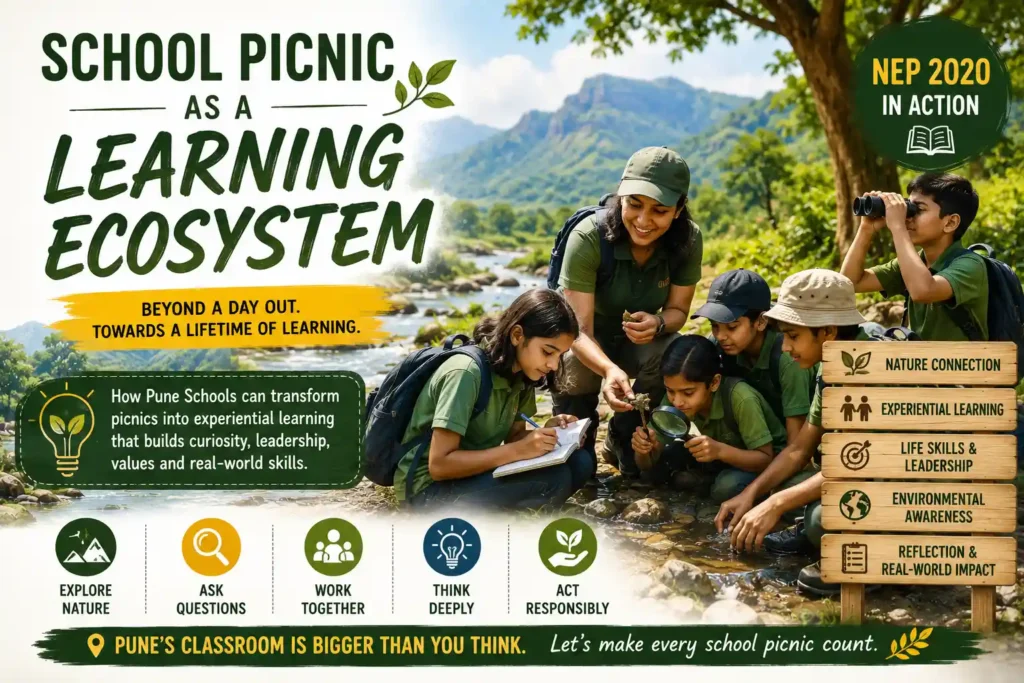

School Picnic for Pune Schools | NEP 2020 Outdoor Learning & Nature Education

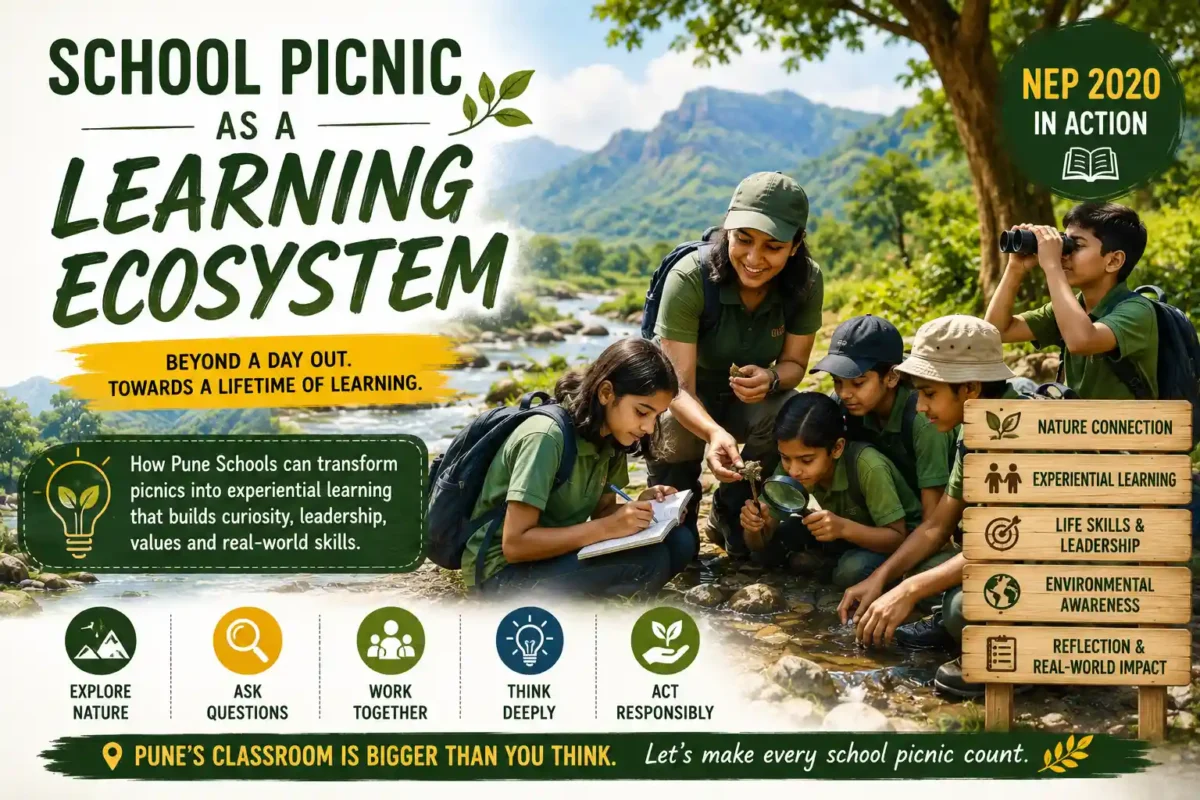
A school picnic is often planned as a welcome break from timetables, classrooms and examinations. Children travel together, eat together, play together and return with photographs, stories and tired smiles.
But what if a school picnic could be more than a day away from school? What if it became a living classroom—where a stream explains the water cycle, a forest trail introduces biodiversity, a team challenge reveals leadership, and a quiet moment under a tree helps a child notice their own place in the world?
For Pune schools, this question is especially relevant. The city sits close to the Sahyadris, rivers, farms, forests and rural communities. These landscapes are not merely destinations for an annual outing. They are learning ecosystems waiting to be thoughtfully included in school education.
The National Education Policy (NEP) 2020 calls for education that moves beyond rote learning towards holistic, experiential, inquiry-based and competency-focused learning. It asks schools to help children connect knowledge with life, local context, values, skills and real-world challenges. A well-designed school picnic can become one meaningful way to bring that intention alive.
For school leaders, this creates an important opportunity: how can the annual school picnic become part of the academic and developmental journey of students?
A meaningful outdoor programme can support several NEP-aligned goals.
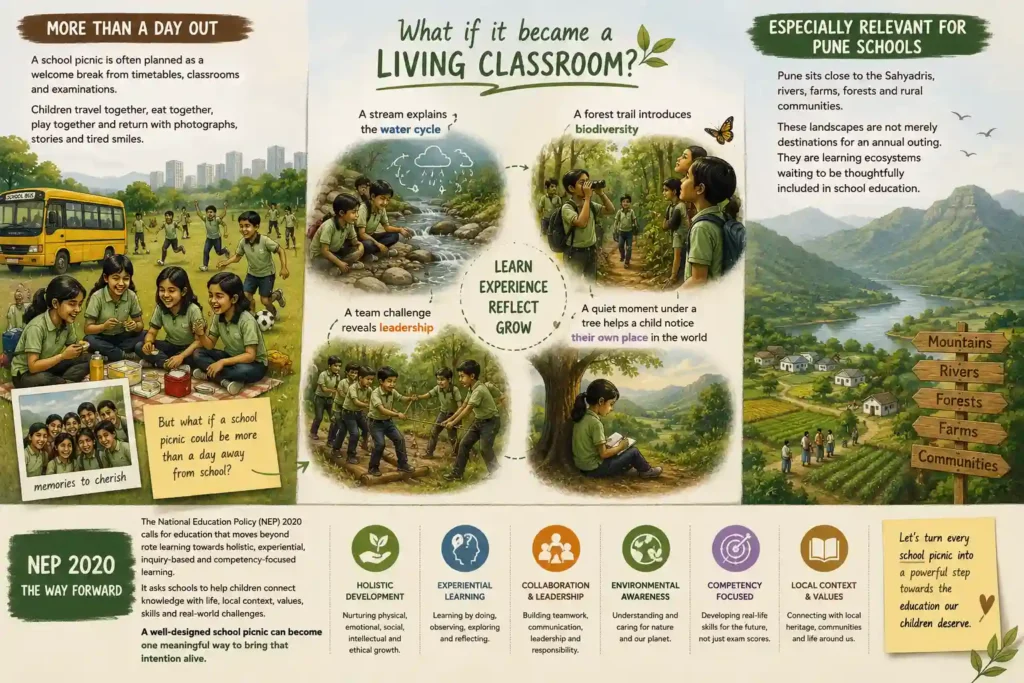
Experiential Learning
Children learn by doing, observing, trying, failing, discussing and reflecting. Building a simple raft, identifying insects, navigating a trail, testing water flow or completing a team challenge can turn abstract ideas into personal understanding.
The activity itself is not the learning. The learning emerges when students are encouraged to observe, ask questions, make connections and reflect on what happened.
Holistic Development
A child’s development is not limited to academic achievement. Outdoor experiences can create space for physical confidence, emotional regulation, social interaction, curiosity, responsibility and decision-making.
For some children, a nature trail may be their first chance to lead. For others, it may be their first experience of being comfortable with mud, rain, silence or uncertainty.
Environmental Awareness
Climate change, water conservation, biodiversity loss and waste management are not distant topics. They are local realities. Pune and the surrounding Sahyadri landscape offer rich opportunities for students to understand these issues through direct observation.
A child who learns to notice a river, a tree, a bird or a patch of soil may grow into an adult who values and protects them.
Collaboration and Leadership
Outdoor learning naturally creates situations where students need one another. They must listen, wait, coordinate, encourage and make decisions.
These are not “extra” skills. They are essential life skills.
Reflection and Assessment
NEP 2020 also moves education towards more holistic assessment. A school picnic can include simple reflection tools: observation journals, group discussions, student presentations, sketches, photographs, questions collected during the day, or a classroom follow-up project.
This helps schools see the outing not as a break from learning, but as a source of learning evidence.
Designing Different Experiences for Different Age Groups
One programme cannot serve every age group equally. A Grade 1 student and a Grade 10 student may visit the same forest, but they should not be asked to learn in the same way.
Grades 1–2: Wonder Before Information
For younger children, the priority is comfort, safety, sensory exploration and joyful curiosity.
Useful experiences may include butterfly trails, nature games, storytelling, farm visits, sensory walks, simple art with natural materials and short river-side observation.
The central question is not, “Can they remember the names of five insects?” It may be, “Did they notice something they had never noticed before?”
Grades 3–5: Exploration and Connection
At this age, children can begin to observe patterns and relationships.
They can explore food chains, water cycles, bird behaviour, plants, insects, simple maps and local ecosystems. Nature treasure hunts, guided trails and group challenges can help them develop inquiry and teamwork.
The focus can shift from “What is this?” to “How is this connected?”
Grades 6–8: Challenge, Skill and Responsibility
Middle-school students are ready for more structured outdoor challenges.
Jungle treks, river ecology, map reading, orienteering, team tasks and supervised adventure activities can build confidence and responsibility. Students can also begin discussing human impact on ecosystems and the choices communities make around water, forests and waste.
Grades 9–12: Inquiry, Leadership and Action
Senior students can engage with deeper questions: climate change, conservation, biodiversity, watershed systems, sustainable tourism, citizen science and community responsibility.
They can collect observations, analyse local issues, lead group tasks and create action plans for their school or neighbourhood.
A one-day experience may not solve an environmental challenge. But it can begin a serious conversation.
The Role of Teachers: Not Just Supervisors, but Learning Designers
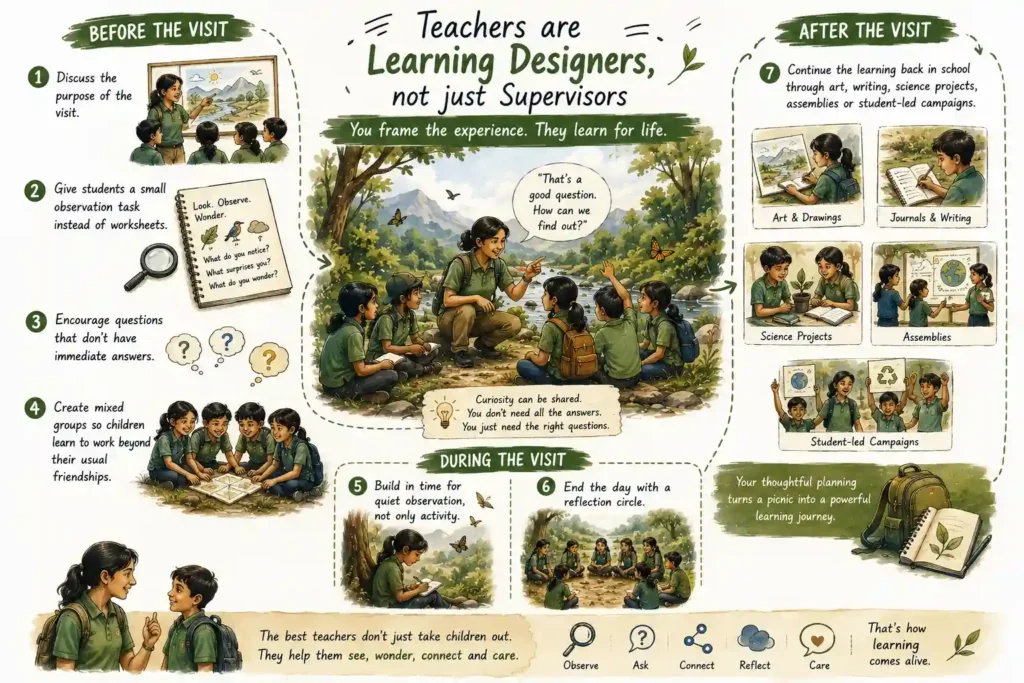
The success of a school picnic depends greatly on how teachers frame it.
When teachers are involved before, during and after the visit, the experience becomes richer. A few simple steps can make a major difference:
- Discuss the purpose of the visit before leaving school.
- Give students a small observation task rather than a worksheet full of answers.
- Encourage questions that do not have immediate answers.
- Create mixed groups so children learn to work beyond their usual friendships.
- Build in time for quiet observation, not only activity.
- End the day with a reflection circle.
- Continue the learning back in school through art, writing, science projects, assemblies or student-led campaigns.
The teacher does not need to know every species in the forest or every detail about a river. Curiosity can be shared. Sometimes the most powerful educational response is: “That is a good question. How can we find out?”
What Should School Management Look For?
For principals, administrators and school coordinators, planning a school picnic requires more than choosing a scenic location.
A responsible outdoor learning partner should offer clear answers on safety, group size, instructor ratio, activity suitability, emergency preparedness, hygiene, food, transport coordination and communication with teachers.
It is also worth asking:
- What are the learning outcomes for each age group?
- How does the programme connect with NEP 2020?
- Is the activity designed for participation, not just entertainment?
- Are children given time to observe and reflect?
- Is the site environmentally responsible?
- How is waste handled?
- Are local communities and natural spaces treated respectfully?
- Can teachers receive a simple post-visit learning resource?
A good school picnic should be memorable. It should also be safe, inclusive, age-appropriate and meaningful.
Parents Are Part of the Ecosystem Too
Parents often ask practical questions first: Is it safe? What will children eat? Who will supervise them? Will they be comfortable?
These questions matter.
But parents can also ask a larger question: What will my child carry back from this day besides photographs?
Perhaps it will be confidence. Perhaps a new friendship. Perhaps a story about a bird. Perhaps an understanding that water does not simply come from a tap. Perhaps the courage to try something unfamiliar.
Outdoor learning does not need to be dramatic to be valuable. Sometimes its deepest impact is quiet.
A Question for Pune’s Education Community
As Pune schools work towards meaningful implementation of NEP 2020, perhaps it is time to reconsider the role of the school picnic.
Can it become a planned learning experience rather than an annual recreational event?
Can nature-based programmes support curriculum, wellbeing, values, environmental literacy and life skills together?
Can schools create a shared framework where children learn before the visit, experience during the visit and act after the visit?
There may not be one perfect model. Every school has its own context, constraints, children and educational philosophy. But this is a conversation worth having.
Teachers, principals, school administrators and parents: what does a meaningful school picnic look like to you?
- What outdoor learning experiences have worked well in your school?
- How do you connect a field visit with classroom learning?
- What support do teachers need to make experiential learning more effective?
- How can Pune schools make school picnics safer, more inclusive and more environmentally responsible?
- What would you like to see in an NEP-aligned outdoor education programme?
Please share your thoughts in the comments. Your ideas may help shape better learning experiences for children across Pune.