



EVOLVE BACK: WHY FAMILIES NEED THIS CAMP NOW MORE THAN EVER

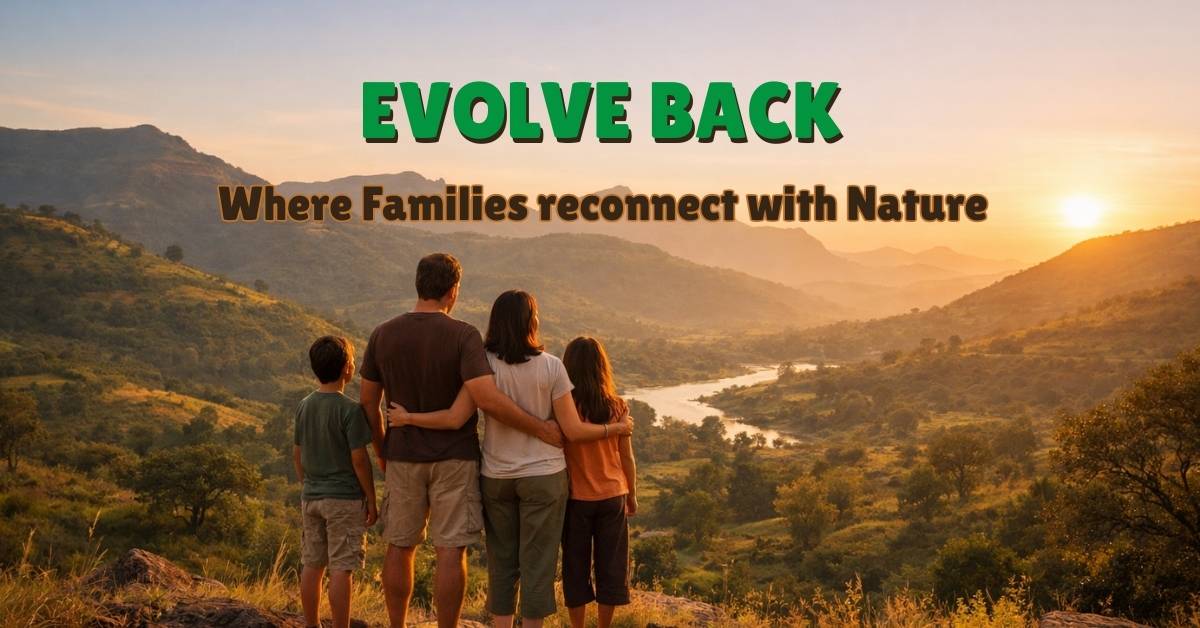
We live in the most connected generation in human history, yet families have never felt more disconnected. A parent scrolls through notifications while a child is trying to share their day. A teenager sits across from the family at dinner, present in body but somewhere else entirely through a screen. Quality time has become something to “fit in” between work messages, school updates, and an endless stream of digital noise.
Smartphones, faster internet, and on-demand entertainment were meant to make life easier. Instead, they often leave families tired, distracted, and strangely lonely. Many parents feel guilty about screen time and lack of presence, but don’t know how to change the pattern without breaking everything else in their lives.
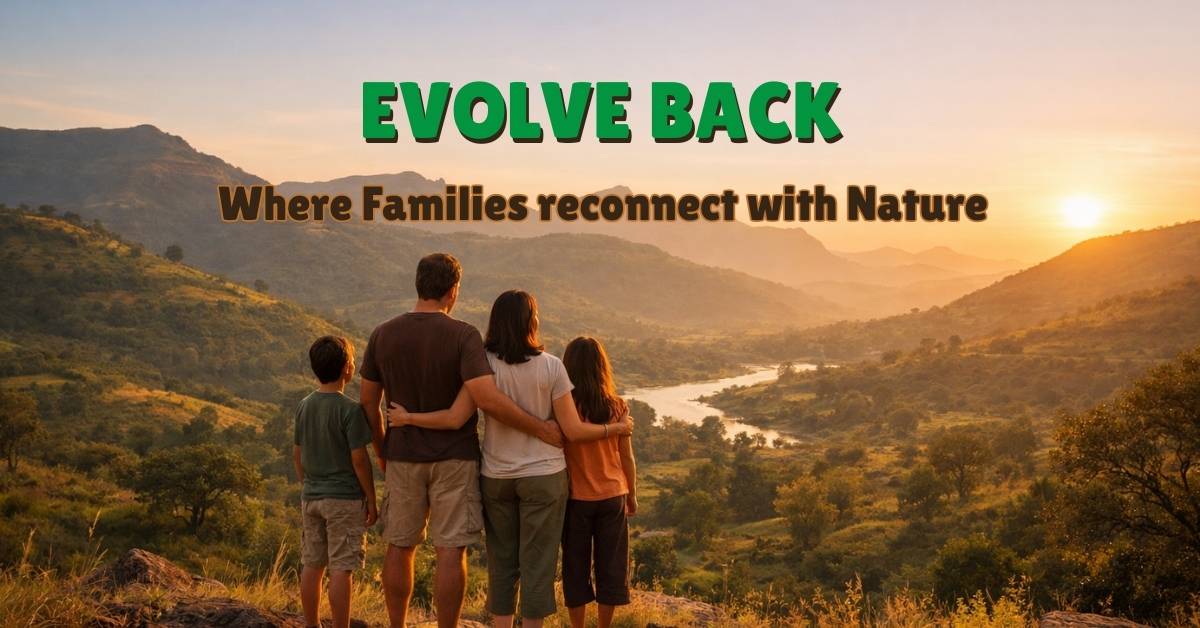
Evolve Back, Nisargshala’s family nature camp near Velhe in the Sahyadri foothills, is built as a gentle but powerful answer to this crisis. It is not “just another weekend outing.” It is a carefully held space where families step out of the digital current, slow down together, and remember what being a family feels like when nature — not the screen — becomes the center of attention.
The quiet crisis inside modern families
Most families know something is off. Children are quicker to reach for devices than for books or outdoor games. Parents are “home” more than ever, yet often mentally somewhere else, pulled into work chats, news feeds, and reels. Everyone shares the same roof, but not the same attention.
In this environment, small but important things start to disappear: unhurried conversations, eye contact, shared silence, the feeling of simply sitting together under the sky without an agenda. Over time, this constant light disconnection creates a deeper emotional gap. Families are “fine,” but the warmth is thinner, the laughter shorter, the memories blurrier.
The hard part is this: most parents are not careless. They are overwhelmed. They have tried phone rules, screen limits, and “no-device dinners,” but the larger system — city life, school demands, social pressure, and technology itself — keeps pulling them back into old patterns. What they lack is not intention, but an environment strong enough to support the reset.
Why a nature camp is not a luxury anymore
Human beings did not grow up inside apps, fluorescent lights, and notification sounds. For most of our history, our nervous systems were shaped by trees, open sky, firelight, rivers, and real human faces. Modern research on attention, stress, and emotional health repeatedly shows that time in nature lowers stress, improves focus, and supports better sleep and mood for both adults and children.
When a family steps into a natural setting like Nisargshala’s valley near Pune, several things shift almost immediately: the light is softer, the sounds are gentler, the air is cooler, and the sense of hurry quietly drops. People speak a little slower. Breathing becomes deeper. Children start noticing small details — birds, rocks, insects, clouds — that usually get filtered out by the noise of the city.
In such an environment, the effort required to “disconnect” reduces dramatically. Phones lose their grip when the stream, the hill, the fire, and the night sky are more interesting than the screen. In other words, nature does a lot of the hard work for parents.
Evolve Back: a space designed for reconnection
Evolve Back is Nisargshala’s answer to a very specific question: “What if a family could step away from its digital and urban habits for just two nights, in a place designed entirely around slowing down, paying attention, and being together?” It is set in the Sahyadri foothills near Velhe, within driving distance from Pune and Mumbai, yet far enough that the usual triggers — malls, traffic, constant pings — fall away.
Instead of a packed itinerary, the camp holds a simple structure: unhurried mornings, open afternoons, shared evenings, and star-filled nights. Families walk on forest paths, sit by natural rock formations, watch birds, listen to insects, and gaze at the sky when it turns from blue to gold to deep indigo. Children are gently invited — never forced — to observe, ask questions, and play in ways screens cannot reproduce.
There are no loud announcements, no constant activity pressure, and no performance expectations. The design is quiet on purpose, so that something else can become loud again: attention, curiosity, and genuine conversation.
Vikram’s role: guiding families back to what they already know
A camp like this lives or dies by the quality of its guide. At Evolve Back, that presence is Vikram — the camp lead and nature guide whose work is less about “teaching” and more about quietly opening doors. His style is gentle, observant, and rooted in respect for both nature and the emotional reality of modern families.
With Vikram, a simple walk becomes much more than covering distance. He will draw attention to a bird call, a tiny insect trail, a particular rock surface, or the way light filters through a tree. Through these small invitations, children and adults begin to see more, feel more, and think less about what they are “missing” on their phones.
Mindfulness at Evolve Back is not a formal session with closed eyes and rigid posture. It is the natural quiet that appears when a child watches a spider build its web, or when a parent and child sit together on a rock in silence, both looking at the same valley. Vikram simply nudges families toward such moments and then steps back, letting the experience do the talking.
Over the years, guides and educators associated with Nisargshala have helped thousands of children and adults experience the night sky, the landscape, and the forest in this way. Evolve Back gathers that experience into a format meant specifically for today’s overwhelmed families.
Why this kind of camp is especially relevant today
In 2026, screens are not going away. Online classes, remote work, digital payments, and social media are now woven into daily life. The goal, then, cannot be to escape technology completely, but to restore balance and remind families that their relationship with each other and with nature is older and more important than any device.
Evolve Back is relevant now because it acknowledges reality: families are tired, distracted, and longing for something softer and slower — but they do not want guilt, lectures, or unrealistic rules. They want a place where it becomes easy to do what they already know is right for them.
In the safe, open environment of Nisargshala, families practice exactly that. They eat simple, mindful meals together. They spend long stretches outdoors. They sleep in the quiet of the hills instead of the glow of screens. They tell stories by firelight instead of scrolling through other people’s lives.
The real impact happens after the camp
The beauty of an experience like Evolve Back is that it does not end when the car leaves Velhe. Families often carry something home — not as a grand resolution, but as a quiet shift. Maybe it becomes a weekly walk without phones. Maybe it becomes one screen-free meal a day that actually feels good. Maybe it becomes a new family story that starts with, “Remember that evening at Nisargshala when…”
Children who have seen the Milky Way with their own eyes, or traced constellations in a truly dark sky, often relate to science and space with a different kind of curiosity. Parents who have felt their shoulders drop and their breath deepen while sitting by a valley or stream find it easier to say “no” to one more late-night message.
Evolve Back is not presented as a magic solution. It is more honest than that. It is a reset point — a strong, clear, nature-filled weekend that helps families remember what they are capable of feeling together, and gives them a reference to return to when city life becomes too loud again.
An invitation, not a prescription
For families near Pune and Mumbai, the Sahyadri hills are close enough to reach within a few hours, yet far enough to feel like a different world. Evolve Back sits in that in-between space — accessible, but intentionally simple. It does not demand that families become “perfectly mindful” or “zero-screen.” It simply invites them to be human again in the most natural setting possible.
In a time when so much is fast, loud, and temporary, a quiet camp in the hills where a guide like Vikram helps families watch birds, trace constellations, listen to trees, and talk to each other without distraction is not a luxury. It is a gentle form of repair.
If there was ever a moment when families needed a place to step away, breathe deeply, and evolve back toward what matters, it is now. And that is exactly what this camp near Pune and Mumbai exists to offer.
Regards
Hemant S Vavale
9049002053
To join next EVOLVE BACK camp, pls click here
Well Done Hemant,
In a world of extreme digital saturation, such initiatives are a reassuring factor for humankind, that hope exists and all is not lost…