
Precession – The Hidden Cosmic Clock
The Earth does not merely spin and circle the Sun; it also remembers. Slowly, almost imperceptibly, its axis traces a vast circle in space, completing one turn in nearly 26000 (twenty-six thousand) years. This motion—precession—silently shifts the backdrop of stars, alters the timing of equinoxes, and reorders the sky across ages.
Civilisations rise believing the heavens are fixed, while the heavens quietly move on. Precession is thus not just an astronomical phenomenon, but a hidden cosmic clock, measuring time on a scale larger than empires, scriptures, and recorded history.
……The sky does not stand where we first saw it,
Nor do the stars keep their ancient vows.
A patient axis writes circles in the dark,
While ages pass unnoticed beneath our feet.
Time turns—without a sound……
……. Appa
Let us attempt to understand PRECESSION -a slow motion of the heavens and its influence on Nature, Time and our very thought.
The Quiet Turning of the Sky
Among the many motions of the Earth—its daily rotation, its yearly revolution around the Sun—there exists a far slower, far subtler, and far more important movement called axial precession. Invisible to ordinary perception, it unfolds across many thousands of years, slowly altering the orientation of Earth’s spin axis relative to the fixed stars. This gradual motion, taking nearly 26,000 years to complete a cycle, has shaped astronomical observation, climate rhythms, calendars, and even humanity’s symbolic understanding of cosmic time. This is the movement has existed since Earth began, the formation of the Lands, the primordial soup in which the very first of the chemical reactions led to the ultimate formation of life, it witnessed the first of the Vegetation, the first of the cells, the first of the fishes, the first of the amphibians and the coming and going of Dinosaurs. It saw first the Hominids that became Man, and today it sees ME writing this note as I attempt to see and say what happened, what is happening and what may happen.

To study precession is to engage with time at a scale beyond individual lives or even civilisations. It is an intellectual exercise that will make us join physics with history, mathematics with mythology, and observation with imagination.
What is axial precession?
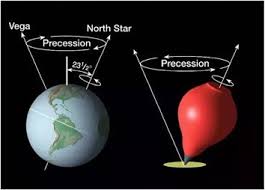
Axial precession is the slow, conical wobble of Earth’s rotation axis. While the axis remains tilted at approximately 23.44° relative to the plane of Earth’s orbit (the ecliptic), the direction in which it points changes.
This causes the following.
- The celestial poles trace circles in the sky.
- The equinox points shift westward along the ecliptic.
- The background stars associated with seasons gradually change.
This motion is analogous to a spinning top whose axis traces a circle as gravity pulls on it.
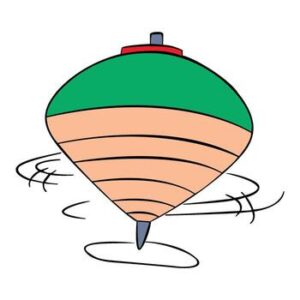
Factors that influence a spinning top
- Tops spin because of torque, which is the willingness of a body to rotate.
- Which is because the potential energy of the top
- That is converted to kinetic energy.
- Rotation action takes place because of angular momentum
- Angular momentum is the product of angular Speed and the mass
- The spinning top will continue to spin if there were no Gravity or Friction
- BUT THEY DO EXIST SO THE TOP SLOWS AND THE TOP ROTATES AT ANOTHER AXIS, THIS IS CALLED WOBBLE
- THE CIRCLE TRACED BY THE WOBBLE IS PRECESSION
It must be noted that when speed is high, precession is low; when gravity takes over, precession is high. Torque does not topple the top directly. It rotates the direction of angular momentum. This sideways change produces precession.
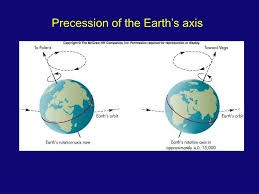
The Physical Cause -Gravitational Torque
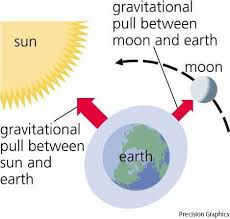
Earth is not a perfect sphere. Due to its rotation, it has an equatorial bulge—a slight outward swelling at the equator. The Moon and the Sun exert gravitational forces on this bulge, attempting to align Earth’s equator with the plane of the ecliptic.
Because Earth is spinning, this torque does not cause the axis to fall over; instead, it produces precession. The Moon and the Sun exert their respective gravitational forces upon the Earth. Moon’s effect is about 67%, andthe Sun’s effect 33%
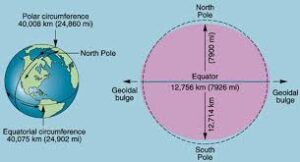
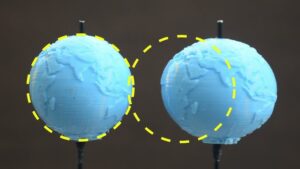
The bulge at the equator
Mathematics explained
A fundamental astronomical behavior or phenomenon is explained by one of the three (3) Laws of Planetary motion proposed by the German astronomer Johannes Kepler called as Equal Areas in Equal Times principle — which when seen in simple layman terms – A line connecting a planet to the Sun sweeps out the same amount of area in the same amount of time, regardless of where the planet is in its orbit. This only goes to show that Planets move faster when closer to the Sun (perihelion) and slower when farther away (aphelion) to cover equal areas.
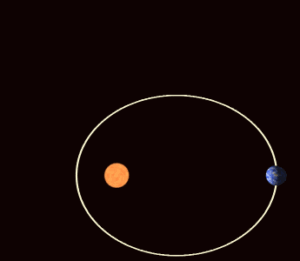
The factors that influence
- The angular velocity
- The force of gravity that the Sun and Moon exert causes the Earth to have a gravitational torque, and that makes the axis point in a tilted manner and trace a circle when viewed from the top.
- This axial circle takes 26000 years to complete one rotation
- The pole star, or the NORTH POINTING STAR, changes depending upon the trace of the circle.
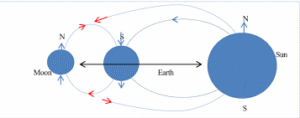
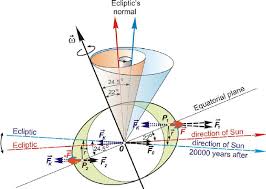
Precession of the Equinoxes
Equinox is the point where the Sun crosses the celestial equator. This happens twice, once in March (but still taken from April) and once in September. On the day of the equinox, night and day are of equal length. The axis of the Earth keeps pointing in a different direction due to the gravitational torque, and the point of the equinox shifts backwards.Since the Earth is rotating West to East, it is clear that the equinox shifts westwards,
Equinox is now in MEEN (PISCES); it is gradually shifting to KUMBH (AQUARIUS). It moved to MESH (ARIES) in 1700 BC. Around April 14th, we celebrate VISHU /BIHU/BAISAKI, etc., which is a new year identified with the EQUINOX as the Sun entering MESH and continues to be the FIRST POINT for all our astronomical calculations. Even though we know the point has shifted, we keep the tables intact and adjust mathematically for the shift.
January 15th is traditionally celebrated as the Winter Solstice (MAKARA SHANKRANTHI) (SUN OVER TROPIC OF CANCER), but precession has shifted it to 21st December, but calendars are still operative with 15th January.
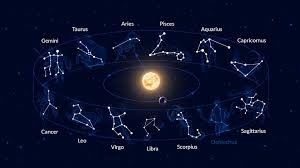
Equinox from 1700 BC in Aries
Equinox Now Pisces
Equinox in 2600 Aquarius
Changing Pole stars
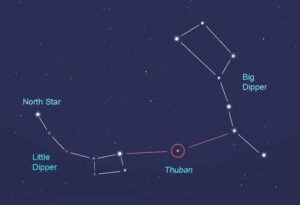
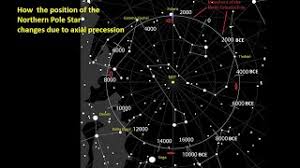
The next pole in Cepheus
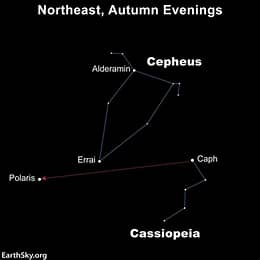
The Sequence of previous Pole Stars
EDASICH (The Hyena) in the constellation Draco, called scientifically as IOTA Draconis, approximately 4800 BC to 3900 BC
THUBAN in Constellation Draco, called scientifically as ALPHA Draconis, approximately 2800 BC to 1900 BC
For almost 6000 years, the POLE was in DRACO. In Earth’s History we call this the Neolithic period or early Chalcolithic period.
It shifted to URSA with KOCHAB in 1900 BC till 1000 AD -1100 AD when Polaris took over the mantle as the present Pole. This shall be maintained till about 3000 AD: Polaris (Ursa Minor) shall be the North Star, getting closer to the pole.
At about 3000 – 4200 AD, the pole shall transit through Cepheus, with Gamma Cephei (Errai) becoming the closest star to the North Celestial Pole around 4200 AD.
At 4200 – 7500 AD The pole transition continues through Cepheus, passing other stars like Iota Cephei and Beta Cephei.
About 7500 AD ALDERAMIN (Alpha Cephei), (NOT ALDEBARAN)!!! Cepheus’s brightest star, which will become the North Star, is still debated as to whether the alignment shall be as perfect as Polaris is today.
About 8000 – 9800 AD The pole moves out of Cepheus and into the constellation Cygnus, with Deneb becoming a prominent, though distant, North Star. This would be the next TRUE POLE STAR; we can see this today as one of the vertices of the summer triangle.
About 13,000 AD: The bright star Vega (Lyra) will be the brightest North Star for a period.
Exactly around 26,000 Years The axial circular trace, because of precession,n brings the celestial pole back near Polaris, completing its cycle!!! Sometimes travel this is!!
Precession and Climate
Precession shapes climates over millions of years, unfortunately Man wants to break this record and alters climate abruptly, over decades.
Because of precession, the timing of seasons slowly shifts relative to Earth’s position around the Sun.
ABOUT 5000 years ago (circa 3000 BCE)
In the Northern Hemisphere, summer occurs closer to perihelion (when Earth is nearer the Sun). Summers were slightly warmer and winters milder. This strengthened monsoons and supported greener landscapes in parts of North Africa, West Asia, and the Indian subcontinent. Rivers were more reliable; early civilisations flourished under relatively stable climatic rhythms.
As precession progressed, it is possible that many early civilisations were drowned in floods, as is evident from historic references in many cultures – Abrahamic – DELUGE – Ancient Indian – PRALAY.
PRESENT (this decade of 2000)
Today, Northern Hemisphere summer occurs near aphelion (farther from the Sun), making summers marginally cooler and winters sharper than 5000 years ago. Precession alone would suggest a slow cooling trend—but this natural signal is now overridden by human-driven climate change, which is warming the planet far faster than any orbital cycle.
ABOUT 5000 years hence (circa 7000 )
Precession will again shift Northern Hemisphere summers closer to perihelion, tending toward stronger seasonal contrasts. If natural forces alone acted, this would gradually amplify summer warmth. However, the actual climate will depend heavily on human choices made in the next few centuries—greenhouse gas levels will matter far more than precession itself.
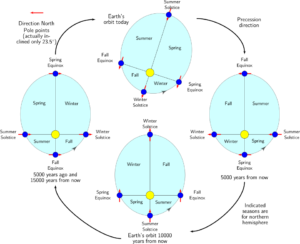
Precession, Calendar and Time
Calendars attempt to synchronise Earth’s rotation, Earth’s revolution, and seasonal cycles. Due to precession Star-based calendars drift relative to seasons, tropical calendars require periodic correction. The Gregorian reform (1582) corrected accumulated processional error by removing 10 days and adjusting leap year rules. The Gregorian calendar was introduced in 1582 CE by Pope Gregory XIII to correct an error in the older Julian calendar.
The calendar that was in use before was called the Julian calendar. This was introduced by the Roman Emperor Julius Caesar in the year 46 BC, and it assumed a year length of 365.25 days, but actually the tropical year (Earth’s cycle relative to the seasons) is about 365.2422 days. This small difference—about 11 minutes per year—caused the calendar to drift slowly with respect to the seasons. By the 16th century, the vernal equinox had shifted about 10 days earlier than its traditional date (March 21). To correct this: to make this effective, people slept one day and woke up ten days later because 10 calendar days were skipped.
People slept on Thursday, 4 October 1582, and woke up the next day on Friday, 15 October 1582.
A new leap-year rule was adopted: Years divisible by 4 are leap years, barring the exception of century years (e.g., 1700, 1800, 1900, 2000), because they need to be divided by 400 (e.g., 1600, 2000). This correction reduces long-term drift and keeps the calendar aligned with the seasons to within approximately one day over 3,000 years. Hopefully, some Pope in 4582 will bring about a second correction, because the equinox will be in Aquarius.
The entire Ancient Indian concept of Yuga is directly linked to the precession; this is a very detailed analysis of time measurement and precise mathematics based on cosmic shifts. It shall have to be dealt exclusively in a separate blog, please await – “Yugas, Time as seen from the Stars“
Modern Application
Precision impacts significantly. The Star position correction (epoch systems like J2000.0), Satellite navigation, GPS, Earth rotation modelling, Star tracking, Missile, in which grave errors are observed, which is why India chose to go with NAVIC for its defence in IACCS (Integrated Air Command and Control System), Climate and Weather modelling
Conclusion
As this slow, almost imperceptible turning of Earth completes its vast circle across millennia, precession reminds us that time in the cosmos moves with a patience far beyond human calendars. Civilisations rise, stars shift their ceremonial roles, and myths quietly realign, yet the sky never hurries.
Even in the age of digital precision, “precession” remains unavoidable
To study precession is to recognise that Earth itself is a thinker—nodding, remembering, forgetting, and renewing—guiding humanity to humility before cosmic time, and to wonder at a universe where even change moves with grace.
अप्पा: उवाच:
कालचक्रे भ्रमत्यक्षो भूमेः सूक्ष्मेण वेधसा ।
युगान्यतिक्रमन्त्यत्र तारकाः साक्षिणः स्मृताः
Appa uvacha
Kāla-cakre bhramaty akṣo bhūmeḥ sūkṣmeṇa vedhasā |
yugāny atikramanty atra tārakāḥ sākṣiṇaḥ smṛtāḥ ||
Appa says:
“Upon the wheel of time, Earth’s axis slowly wanders by a subtle divine motion. Here, ages pass one into another, while the stars are remembered as silent witnesses.”
To contemplate Earth’s precession is to stretch the mind beyond ordinary time. It reveals a universe where change is constant yet gentle, precise yet poetic. Writing about it is an act of intellectual meditation—one that connects mathematics with memory, astronomy with awareness, and science with wonder….
I am indeed blessed. Thank you, Nisargshala ….
We invite you all to come and see many such wonders.

Appa
Tales, Tails & Trails
Ram Iyer retired as the Project Director from the Science & Technology Park, an initiative of the Department of Science & Technology, Govt. of India, with a B.Tech. and an MBA from the University of Delhi. Getting Bharat, that is India, back to its roots through Ancient Vedic Wisdom and Science & Technologies is the mission he is on. Post-retirement, he actively supports Nisargshala’s mission, lending his scientific knowledge to nature-based education and stargazing initiatives
You are right Ram , our Vedic knowledge treasure house is not only the basic truth backed by scientific explanations & perfect astronomical & mathematical computation. Evolution of Scientific renaissance in the west has officially or un officially stolen concepts from the Vedas & plagiarised it as their findings !
Sir
Its an honor to receive a word from you …Our efforts would be be blessed a 1000 times more if your comments are seen posted in all the blog articles , we are trying to create an ecosystem of improved knowledge and understanding .Please support us
Ram
A quick browsing has left me to say the following
You are at an advanced level of understanding the mystic collaboration of the cosmic configuration.
I suggest that you have Two versions of what you want to convey
One that is as technical as you have presented
The second, a lay man’s version which conveys all that in a lucid manner
Just a lay man’s suggetion
With best wishes for continued efforts
God bless you and your family
TN Sundar
Anna,
You are by design generous so cant say much.
Whenever you deaire i will be honorwd to explain all of my blogs in a very simple talk of the street mannwr