
A Two -part reflection on trees, stars, time, and human witnessing
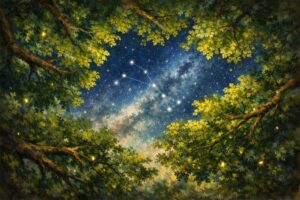
Under a green canopy
Breath learns its own measure
Above a slow constellation
Keeps time without a witness
Root and Star listening together
…. Appa
Part -1 Roots That Look at the Sky
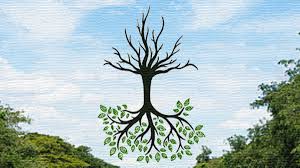
The inverted Ashvath described in the Bhagavat Gita Adhyay 15 1-3
The tree stands rooted
Counting fires across the night sky
Waiting still for the rain
……..Appa
Most trees do not merely grow upward. They seem to look. Across cultures, trees have been placed beneath the sky not as passive growths, but as quiet witnesses to cosmic order. In Indian thought, the tree and the star are not separate realms. One anchors, the other guides. One remembers time, the other measures it. When we stand beneath a tree at night, something ancient aligns. The roots hold the earth steady while the crown opens itself to light that has travelled for thousands of years. In that moment, the human being stands between — neither rooted nor luminous, but aware. Ancient Indian thought did not view the sky as distant. Phenology (the concept of seasonal cycles) is at the heart of our “THINK GREEN” philosophy in Agriculture and Forestry. It is because we have forgotten these fundamentals that we face the environmental crisis.Tree and Star Assignment
It brought the heavens down to earth, quite literally, by assigning each Nakshatra a living tree.Nakshatras are not mere sparkles in the sky; they are qualitative fields of time. To each such field, a tree was associated — not as ornament, but as embodiment. The tree rooted celestial rhythm into soil, water, and breath.
Jyeshta nakshatra
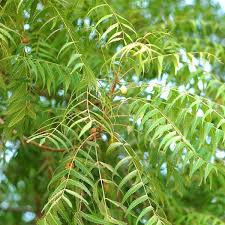
The very useful and revered NEEM tree is assigned to Jyeshta Nakshatra
| Star Name (Indian) Nakshatra | Assigned Tree Common Name | Assigned Tree Botanical Name | |
| 1 | Ashvini | Kuchla | Strychnos nux-vomica |
| 2 | Bharani | Amalaki | Phyllanthus emblica, |
| 3 | Kritika | Udumbara | Ficus racemosa, |
| 4 | Rohimi | Jamun | Syzygium cumini |
| 5 | Mrigasirsa | Khadira | Acacia Catechu |
| 6 | Ardra | Arjuna | Terminalia Arjuna |
| 7 | Punarvasu | Bamboo | Bambusa Vulgaris |
| 8 | Pusyha | Asvattha | Ficus religiosa |
| 9 | Aslesha | Naga Kesara | Mesua ferrea |
| 10 | Magha | Banyan | Ficus Indica |
| 11 | Purva Phalguni | Palasa | Butea monosperma |
| 12 | Uttara Phalguni | Plaksha (white fig) | Ficus virens |
| 13 | Hasta | Ambara (Mango) | Mangifera indica |
| 14 | Chitra | Bilva (bael) | Aegle marmelos |
| 15 | Swati | Arjuna | Terminalia arjuna |
| 16 | Vishaka | Indian Rosewood Sheesham | Dalbergia sissoo |
| 17 | Anuradha | Naga Kesara | Mesua ferrea |
| 18 | Jyeshta | Neem | Azadirachta indica |
| 19 | Moola | Sal | Shorea robusta |
| 20 | Purva Ashada | Palasa | Butea monosperma |
| 21 | Uttara Ashada | Jackfruit | Artocarpus heteroohyllus |
| 22 | Sravana | Asvattha (peepul) | Ficus religiosa |
| 23 | Dhanista | Sami | Prosopis cineraria |
| 24 | Satabhisha | Kadamba | Neolamarckia cadamba |
| 25 | Purva Bhadrapada | Mango | Mangifera indica |
| 26 | Uttara Bhadrapada | Neem | Azadirachta indica |
| 27 | Revati | Mahua | Madhuca longifolia |
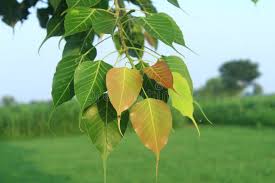
The Peepul Tree
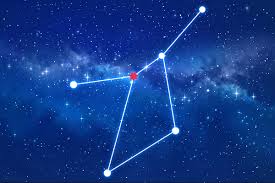
Pushya Nakshatra is assigned to Peepul
Stars as Timekeepers
Stars have served as humanity’s first clocks. Their fixed patterns and predictable motions offered order long before mechanical time. Rising and setting, waxing seasons, solstices and monsoons were read in their paths. Nakshatras divided the sky into lived calendars, guiding sowing, travel, ritual, and rest. Unlike human time, star time does not hurry. It repeats without memory or judgment. Stars mark duration, not meaning. They remind us that time is not owned but observed, not consumed but witnessed. Beneath their gaze, civilisations age, trees grow, and moments learn patience. Silence between stars teaches humility and continuity beyond individual lives along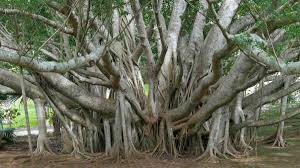
The Banyan Tree

The Magha Nakshatra is assigned to the Banyan tree
A tree is a perfect mediator. Its roots descend like memory, its trunk stands in the present, its canopy reaches the light. In this sense, trees become witnesses — “sakshi”— to both cosmic movement and human life. A tree stands where worlds meet. Its roots listen to the soil, absorbing memory, decay, and renewal. Its trunk inhabits the human realm, offering shade, shelter, and silent witness to lives passing by. Its branches open to sky and light, translating the sun’s fire into breath and balance. In this vertical journey, the tree mediates between earth and heavens, past and future. When aligned with seasons, the moon, and stars, it becomes a living calendar. Without speech or judgment, the tree teaches mediation through presence, continuity, and restraint, reminding humans that harmony is sustained not by dominance, but by attentive participation. This creates a silent, philosophical, seamless connection that our ancients knew and experienceda Sky as a pattern
a Tree as presence
a Human as awareness.
In an age where astrology floats in abstraction and ecology struggles for relevance, the Nakshatra–tree correlation reminds us that we once had a time, we the Bharatiya, when knowledge grew slowly, like a trunk, ring by ring. Perhaps the future of cosmology is not in new calculations, but in remembering which tree belongs to which star. Before clocks divided the day, the sky divided time. Stars as dots were always there. Nakshatras were not invented to predict fate, but to observe rhythm. Farmers, forest dwellers, and seekers looked up to know when to plant, when to wait, and when to let go. Time was not rushed — it was read. Trees to follow such a calendar. They shed, flower, fruit, and rest without argument. Their obedience is not submission, but attunement. In this way, nakshatras and trees speak the same language. One marks the sky’s pulse, the other responds on earth. Between them, human life once found balance. This blog begins a series that explores that connection: tree and star, earth and sky, growth and destiny. Not as belief, but as lived metaphor.The roots hold the soil
The branches hold the stars
Where does the tree reside …Appa
……To be Continued
Part 2– Man, Tree and Stars – The future of Ecological Balance ….